| Mobile| RSS

Showing posts with label education. Show all posts

Historic icons: both a photographer and his work

Civil Rights photographer Charles Moore dies at 79, but his legacy live on.

Talk about the service of awareness ... there's hardly a better example for the power of photographs to bring to light conditions that demand action and attest to the perseverance of humanity right here in our own country. Not to mention the capacity for still photographs to pass into historic icons.

A moment of silence is appropriate, which should be shortly followed by a celebration for a life of service.


Copyright Charles Moore

Go here to view Moore's photographs.

Monday, March 15, 2010 | posted in , | 0 comments [ More ]

Michael Jackson and his role in photojournalism education

When it comes to teaching my class at Georgia Southern University, I'm not ashamed to admit that I steal lots of ideas from others who teach photojournalism.

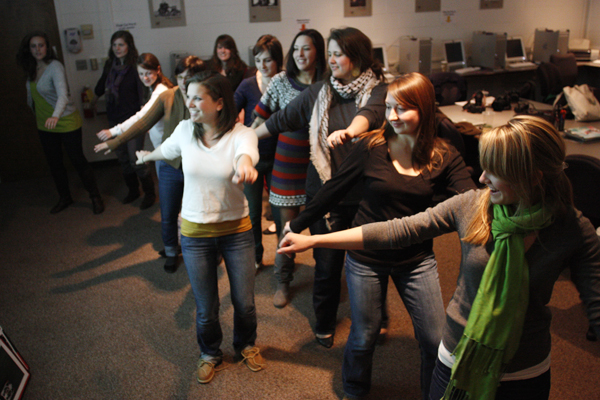
I've stolen more than a couple from my friend Mark Johnson at the University of Georgia. I'm a little undecided about incorporating one of his latest techniques. As you can see, the results can be both horrifying and thrilling at the same time. For the full story, go here.

No mere mortal can resist ...


JOUR5370 dances to "Thriller," Athens, Ga., March 4, 2010. (Photo/Mark E. Johnson, www.mejphoto.com)
Used with permission

P.S. There might be a video on the way.

Friday, March 5, 2010 | posted in , | 0 comments [ More ]

Making the grade: What makes a good picture?

I'm in the process of evaluating my Georgia Southern University photojournalism class' first graded assignment for the semester: portraits.

Their task was to create a journalistic portrait of a subject of their choice. The goal was to communicate something about the unique character and personality of their subject -- in a photograph.

It's a challenge for people who typically evaluate portraits, or any photograph, for their aesthetic value alone. While aesthetics are certainly a consideration, it is not the ultimate standard in photojournalism.

It's something I struggle to explain, at times, because assessing photographs seems like such a subjective thing, on the surface. Personal taste varies wildly, and many beginners have a hard time accepting criticism about a picture, especially when they feel that their grade might not reflect their honest effort.

So what does make a good picture?

Dennis Dunleavy, who teaches photojournalism at Southern Oregon University, wrote a post on his blog about this very topic.

Dunleavy very eloquently (and correctly) asserts that the value of news photographs is in their ability to persuade. Can this photograph make people notice? Can it make them care?

"... a picture, through its variety of visual cues, establishes a context of understanding that shapes perception and constructs a sense of reality," he says.

I told my students, on the first day of class, that this course will not be an introduction to photography, rather it will be an introduction to visual communication.

For the photojournalist, the reward isn't making someone like your photograph. The reward is when people - lots of people - get the message you intend your photograph to communicate. Quickly. Immediacy is one of the most powerful attributes of the still photograph. You will lose most of your audience if they have to search and ponder for meaning or relevancy.

Things like composition, angles, perspective, and lighting are aesthetic qualities. They are important, but in the end, they are simply tools to help achieve the real goal: communication.

Portraits can be complex, providing multiple visual clues about their subjects: expressions, gestures, body language, clothing, props, background objects. But some of the most powerful portraits are simple. 

One of the most famous portraits ever made, a photograph of Afghan girl Sharbat Gula made for National Geographic by Steve McCurry in 1985, is a study in simplicity. Little more than a head-and-shoulders shot, made against a door, providing a soft, monochromatic background. In this simple portrait, there are multiple, though subtle, visual clues about the the girl. But what made the photograph so memorable was her eyes.

Those eyes. They still allow us to connect, twenty-five years later, in a very immediate and emotional way to a girl and her people who were fleeing conflict between the Soviet Union and Afghan rebels.

I've said it before, and I'll say it again. It's about connections. Emotional, universal connections.  

That's what makes a good picture.

Friday, February 12, 2010 | posted in , , , | 0 comments [ More ]

Learning from the best ...

UGa photojournalism students document professionals at work

My good friend Mark Johnson teaches photojournalism at the University of Georgia's Grady College of Journalism and Mass Communication.  As one of their projects, he has his advanced photojournalism students shadow a professional photojournalist and create a "day in the life" multimedia slideshow. I thought I'd share a couple of examples of their work so a small voice visitors can learn along with the students.

Student Jake Daniels followed Miami Herald staff photographer Patrick Ferrell. Ferrell is the latest recipient of the Pulitzer Prize for Breaking News Photography for his photographs of the people of Haiti in the tragic aftermath of back-to-back hurricanes. His work and his words carry a lot of weight. Listen carefully to his account of the experience, and you might begin to understand how and why photographers make pictures of such horrific events.
WARNING: Many of these pictures are of a graphic nature and may be upsetting. They should be. Many people died, including a lot of children. But Ferrell's photos gave a voice to people who desperately needed one.


Daniels' classmate Lindsay Dobras shadowed yours truly. I can't say her experience fits the headline of this post, but I enjoyed our time together and I hope she learned some things. To view her slideshow, click here: A Day in the life with Scott Bryant.

Good job Linsday, but it still feels weird being on the other side of the camera!

If you're interested in seeing more of the students' work, click here: Advanced Photojournalism. Then click on the names to view their work. The "Day in the Life" slideshows are featured on the "November 17, 2009" link.

Monday, December 14, 2009 | posted in , , , | 0 comments [ More ]

Twitter